
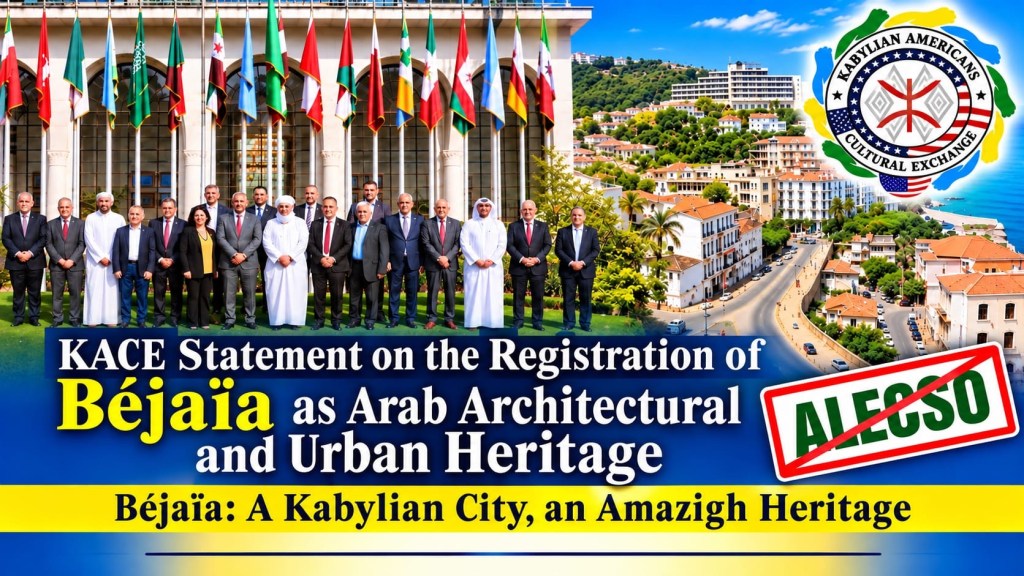
The Kabylian Americans Cultural Exchange Organization (KACE) is deeply alarmed by the decision to add and register the city of Béjaïa for its architectural and urban heritage by the Arab League Educational, Cultural and Scientific Organization (ALECSO), an organization affiliated with the Arab League.
KACE strongly denounces the announcement made during the 11th Meeting of the Observatory of Architectural and Urban Heritage in Arab Countries, held at the headquarters of the Arab League in Egypt from October 25 to 27, 2026.
Béjaïa is located in Kabylian territory, a historic land of the Amazigh people with a distinct history, cultural heritage, and identity. KACE considers the classification of Béjaïa within an Arab heritage framework to be a serious distortion of the city’s historical and cultural identity.
This nomination was promoted by the Algerian Minister of Culture and Tourism; it represents an act of cultural hegemony over a millennia-old heritage rooted in the Mediterranean and North African world. It risks appropriating a unique civilization and historical legacy that has endured through centuries of foreign domination and resisted successive invasions and occupations, including those of the Romans, Turks, and Arab conquerors.
KACE believes that placing a historically Kabylian and Amazigh city within an exclusively Arab cultural framework disregards the complexity of its history and undermines the cultural identity and dignity of the Kabylian people.
KACE therefore calls upon ALECSO and the Arab League to:
- Review the registration and classification of Béjaïa within the Arab architectural and urban heritage framework;
- Repeal the designation in light of Béjaïa’s historical Kabylian and Amazigh heritage;
- Recognize and respect the distinct cultural identity and history of Kabylia and its people;
- Issue an apology to the people of Kabylia for the cultural misrepresentation of Béjaïa’s heritage.
KACE stands firmly for the preservation of historical truth, cultural diversity, and the right of every people to have its heritage recognized and represented according to its own history and identity


Leave a Reply