
By T. Malha
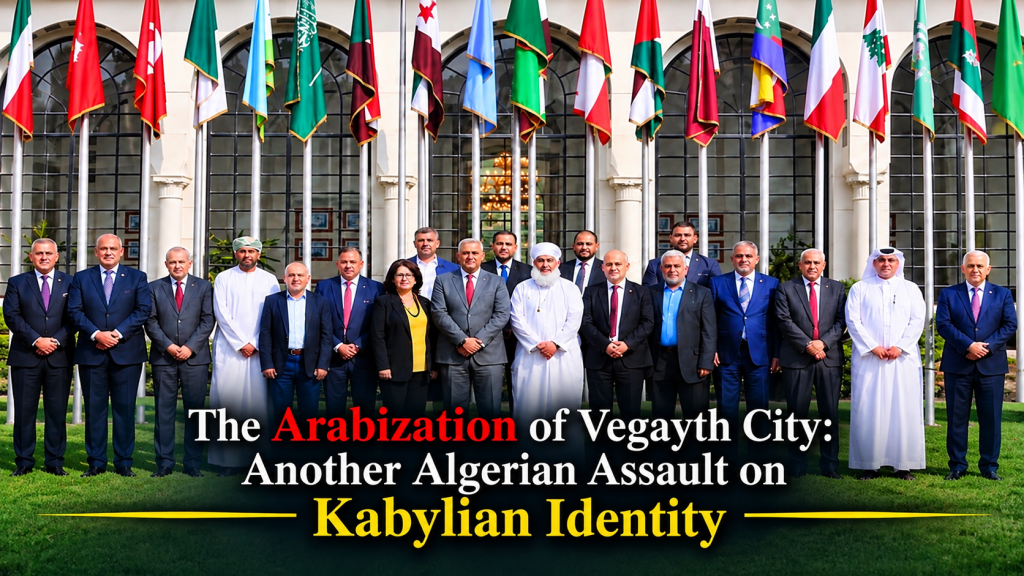
(Kabylia)–Vegayth, a Mediterranean city and an integral part of Kabylia, belongs to the Amazigh world and is deeply rooted in the history, identity, and cultural heritage of the Kabylian people. Throughout its history, this land has endured successive attempts at domination, from the Roman Empire to French colonialism, while its people have continually struggled to preserve their identity, language, and freedom.
However, in a surprising announcement, Vegayth was recently registered and included among Arab cities recognized for their architectural and urban heritage by ALECSO (the Arab League Educational, Cultural and Scientific Organization), an institution affiliated with the Arab League.
The statement was made during the 11th meeting of the Observatory of Architectural and Urban Heritage in Arab Countries, held at the Arab League headquarters in Egypt from October 25 to 27, 2026.
This opportunistic decision raises serious questions about cultural identity, history appropriation, and respect of human cultures and memories. How can a city belonging to the historical territory of Kabylia be incorporated into an Arab cultural framework without adequately acknowledging its Kabylian and Amazigh roots?
This appalling registration represents another example of the systematic appropriation of the Kabylian historical and cultural heritage. It also raises concerns about the Algerian state’s approach to the identity of the territories and peoples that are under its control.
The Algerian Minister of Tourism, who reportedly promoted this registration is participating in a broader state policy that erases the Kabylian identity. Indeed, such actions reinforce the perception that Algeria treats Kabylia not as a distinct historical and cultural territory deserving recognition as such, but as a space whose identity must be reshaped to fit the state’s dominant national narrative as its authorities and media claim – Algeria is an Arab state, Islam is its unique religion.
This is not a new sabotage case. In fact, in April 2025, Algeria submitted a nomination file to UNESCO seeking the inscription of “The Art of Adorning the Female Attire of Kabylia with Enameled Silver Jewelry: Craftsmanship, Confection, and Wearing.” Although the nomination concerns a genuine and distinctive Kabylian cultural tradition, the question remains: why should the recognition and international representation of Kabylian heritage depend exclusively on a state that has long been criticized by Kabylians for marginalizing their language, identity, and oppressing Kabylians?
For more than six decades, since Algeria gained independence in 1962, Kabylian identity has faced persistent political and institutional pressures. The Kabylian language, culture, and historical heritage have struggled against policies that have favored Arabization and the promotion of a singular national identity at the expense of the country’s Amazigh diversity.
The objective, as perceived by many Kabylians, has been to weaken their distinct identity and gradually assimilate them into an Arab cultural and linguistic framework. The consequences extend beyond language policy: they concern historical memory, cultural transmission, education, and the international recognition of Kabylian heritage.
However, Kabylians have never accepted the disappearance of their identity. Their continued resistance to cultural and linguistic assimilation has demonstrated their determination to preserve their heritage and assert their right to define themselves.
Faced with this persistent resistance, the strategy of the Algerian colonial regime appears to be evolving and fallacious. Beyond linguistic and political assimilation, cultural co-optation has increasingly become its new line of attack. Rather than simply marginalizing Kabylian heritage, the state is now appropriating it, presenting it internationally under the Algerian or Arab cultural narrative.
The registration of Vegayth as an Arab city is therefore more than a question of architectural classification. It is a deliberate attempt to manipulate people’s history, identity, and cultural heritage.
Kabylia is not an Arab territory, and doesn’t share any historical facts with Arab nations. It is an integral part of the Amazigh world, with its own language, traditions, historical memory, and cultural identity.
Recognizing the architectural heritage of Vegayth city by a foreign entity without consulting its inhabitant is simply a cultural terrorism against its people’s heritage.


Leave a Reply