
By T. Ferroudja
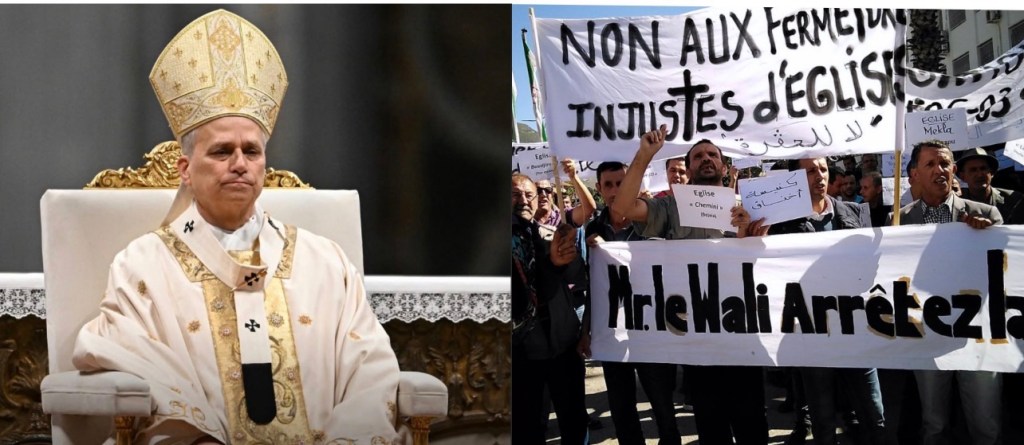
(Algiers)–The Holy Pope Leo XIV is scheduled to visit Algeria. According to the Vatican News, the Pope will land in the capital Algiers on Monday, April 13th, and his visits will end on April 15th. This is an unprecedented papal visit to Algeria, since no acting pontiff has ever visited Algeria — a former stronghold of ancient Christianity. In fact, prior to the Arab conquest, which imposed Islam by sword in the 7th century in the Northern African region — Tunisia, Morocco, Algeria, Egypt, Libya — the population at that time was mostly pagan and Christian.
Pope Leo XIV indeed was influenced and shaped by the teaching and legacy of Saint Agustine, who was born in 354, at Thagaste (currently Souk Ahras), in North Africa (former Numidia).
Pope Leo XIV has already met the Algerian President Abedlemadjid Tebboune in the Vatican on July 24th, 2025. During their meeting, Tebboune handed over an olive branch as a gift to the Pope which was picked at Saint Augstine’s olive tree.
It appears both personalities have found a common ground at a time of great turmoil affecting the closures of Protestant churches in Algeria — numerous are located in Kabylia. However, Tebboune doesn’t hold decision-making power — he was brought to power by the military nomenclatura – who is the real decision-maker in a major country’s issues.
This visit is scheduled in the midst of Algeria’s isolation and weakness at the international level. Algeria has lost several international partners because its leader lacks popular legitimacy, institutionalized corruption, and also because of its absurd and erratic policies. Also, the Algerian dictatorship has entertained tight relationships with authoritarian regimes, notably, Russia, Iran, Venezuela of Maduro, and Syria of Bashar El Assad. In addition, it supports terrorist groups and organizations, particularly, the Hamas movement and the Polisario. Furthermore, it promotes terrorism in the Sahel region.
Yet, after Putin’s war in Ukraine, Italy and Spain have developed economic relationships with Algeria for pragmatic reasons — They needed the Algerian gas for their population and economic growth to the detriment of democratic values and human rights.
Again, Algeria to polish and improve its image approached the Vatican, then acted to invite Pope Leo XIV to exploit his venerated personality and leadership.
Now that the Holy Pope Leo XIV is visiting Algeria, would he be able to openly rebuke the Algerian military regime over human rights abuses targeting political and social activists, including tightening the condition of Christian community, notably, the Protestant one, since 2017?
Algeria is an intolerant and discriminatory state towards other religions. The Algerian state imposes Islam as the state’ religion by article 2 of the constitution which stipulates: Islam is the state’s religion.
In Algeria, as in the Muslim world, renouncing the Muslim religion is an unacceptable act and punished under Sharia law as apostasy.
Article 2
Islam shall be the religion of the State.
In Kabylia, over 40 churches have been closed. Also, a social media who had over 50,000 members was pushed to be deleted. Subsequently, numerous worshipers resorted to secretly worship through underground networks to maintain their faith. This led the Algerian authorities to arrest several devotees and engage in lawsuits against them under article (5 & 6) of ordinance #06-03 of February 28, 2006, establishing the condition and rules for the practice of religions other than Islam.
CONDITIONS FOR THE PRACTICE OF WORSHIP
Article 5
The allocation of a building for the exercise of worship is subject to the prior opinion of the national commission for the exercise of worship provided for in article 9 of this ordinance.
Any activity in places intended for the exercise of worship that is contrary to their nature and the purposes for which they are intended is prohibited.
Buildings intended for religious worship are subject to registration by the State, which ensures their protection.
Article 6
The collective practice of worship is organised by religious associations whose creation, approval and operation are subject to the provisions of this ordinance and the legislation in force.
In fact, the dystopian reality is that this ordinance was tailored-made to make it difficult, and even impossible for the natives population to receive permits for their buildings to worship freely – Christian communities asking for permits, Algerian religious authorities deny their requests.
We know Muslims in their worshiping culture, they can pray wherever they feel, even on streets. Mosques are allowed to use amplified sound systems to podcast the prayer and preaching, which is a source of noise and disturbance for non-Muslims. However, what I understood from the Algerian religious policy for non- Muslims is that the Algerian authorities are not open and pleased by the fact that Algerians are converting from Islam to Christianity, which is an act of apostasy. This means the ordinance #06-03 of February 28, 2006, is only applicable to foreigners, who already have a Christian faith. They could be tourists, foreign workers, embassies’ staff, but not to the local Algerians.
As I highlighted earlier, the churches that have been closed are located in Kabylia, and it’s not a mere phenomenon! And Kabylians have a tendency to convert to Christianity. Also, some others become pious and choose Christianity as their religion, which is their absolute right.
How to explain this social and religious transformation?
In fact, for Kabylians, Christianity is the antithesis of Islam, which is an imposed religions in Algeria, and, therefore, it is a powerful means that bolsters the alienation and hegemony of the Kabylian people that was implemented by the Algerian state in the post-independence of Algeria by undergoing a forced arabization to the Amizigh people, including the Kabylians.
Thus, Christianity is a kind of a gateway for an ontological, identity and cultural survival for Kabylians in so far as the Kabylian space was invaded by a rampant and hostile Arab ideology that wasn’t well-welcomed in Kabylia.
As a matter of fact, Christianity doesn’t prohibit worshiping in the Kabylian language, Christianity doesn’t have a language, contrary to Islam which imposes Arabic as language of faith – which is a devious ritual leading on the long run to assimilation of non-Arab societies. Subsequently, the Christian community in Kabylia have taken the lead to embrace a religion that is in conformity with its ancestral culture, which doesn’t erode their identity and Kabylian lifestyle: Kabylian christian community is worshiping in Kabylian language, women are allowed to observe the Mass alongside with men, funeral burials services are organized in the Kabylian language, etc.
Seeing this as an act of activism and impediment against the progression of the Arab and Islamic ideology in Kabylia, the Algerian authorities started cracking down on devotees and their infrastructures.
Religious restrictions by denying someone’s freedom to practice freely his/her faith is a blatant discrimination and a human right abuse, and it’s a violation of the Universal declaration of Human Rights. Therefore, Kabylia’s human rights organizations and anonymous activists have reported the infringement of fundamental human rights which have been impacting the Christian community in Kabylia to Amnesty International, Human Right Watch, United Nations and to the Vatican.
Article 18 of Universal Declaration of Human Rights
Everyone has the right to freedom of thought, conscience and religion; this right includes freedom to change his religion or belief, and freedom, either alone or in community with others and in public or private, to manifest his religion or belief in teaching, practice, worship and observance.
Now that the Vatican and Holy Pope Leo XIV have been officially informed since the beginning of this repression, and soon he will be traveling to Algeria as announced by the Vatican, would he be a savior for the Christian minority in Kabylia?
Pope Leo XIV as Cardinal has already criticized the U.S Vice President JD Vance regarding his views on Christianity and migrant treatment, and later as a Pope criticized the Trump administration’s treatment of migrants, its antipathy toward Europe and global institutions like the United Nation.
Recently, Pete Hegeseth, the U.S. secretary of war, asked the American people to pray “every day on bended knee” for military victory in the Middle East” in the name of Jesus Christ”. Pope Leo XIV, in a homily during a Mass on Thursday before Easter, said that Christian mission has been “ distorted by a desire for domination, entirely foreign to the way of Jesus Christ.” This means, the Pope disagrees with Hegseth.
It seems Leo XIV is an outspoken Pope on fundamental issues, however, he officially never brought up the case of human rights violation in Kabylia — for both the Christian community and political activists.
To sum up: First, I hope Pope LeoXIV maintains his agenda, it is really important because the stakes are higher for the Christian minority in Algeria. Second, I profoundly don’t intend to being speculative on this matter since the trip didn’t occur yet, hopefully, the Pope won’t only be on pilgrimage in Algeria, to walk on the steps of Saint Augstine, but also to address to the Algerian government the restrictions, discrimination and mistreatment which its fellow Christians have been enduring, and request an immediate ease of this plight and deliver permits for worshipers.


Leave a Reply