
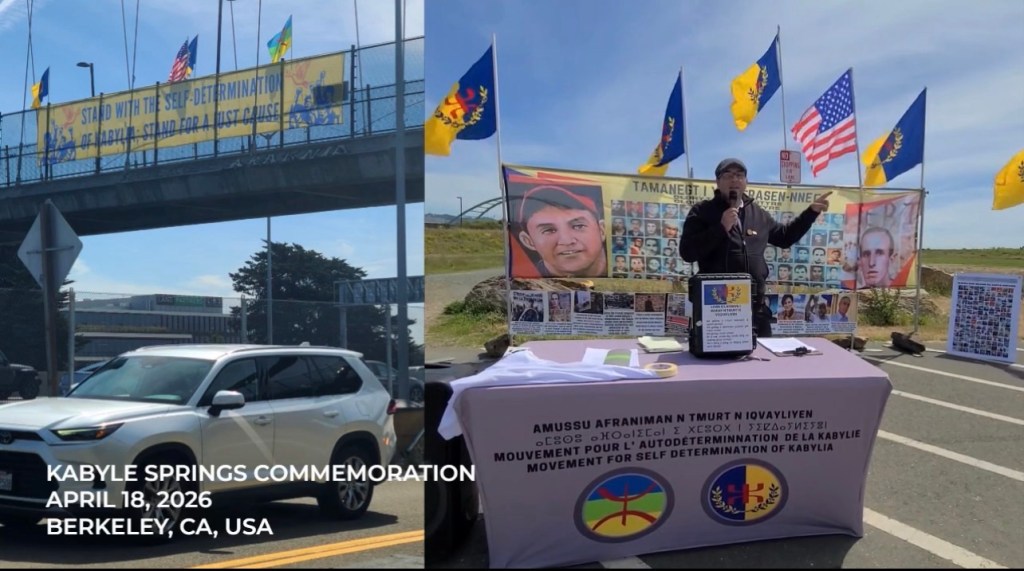
Ladies and gentlemen, Brothers and sisters,
Today, we gather not only to remember—but to affirm, resist, and to hope.
We commemorate the Kabyle Spring of 1980–1981, when people rose with courage to defend their language, their identity, and their dignity. In the face of denial and repression, Kabyle voices declared to the world: we exist, and we will not be erased.
But history did not stop there.
We also stand here to remember the Black Spring of 2001, a tragedy that remains deeply engraved in our collective memory.
On April 14, 2001, Kabylia was shaken by a turning point. Just weeks earlier, a young Kabyle, Massinissa Guermah, was assassinated inside a gendarmerie brigade in Aït Douala, in the region of Tizi Ouzou.
This act ignited an unprecedented uprising.
The response of the Algerian authorities was brutal.
More than 128 Kabyle civilians were killed, and over 5,000 were injured or permanently disabled, many struck by live ammunition, AK-47 weapons, and explosive bullets used against unarmed civilians.
In response, a powerful grassroots movement emerged—the Arch Movement—calling for dignity, justice, and an end to state violence.
On June 14, 2001, history was made.
Nearly two million Kabyles marched peacefully to Algiers, carrying with them hope, determination, and a demand for change. They chanted for justice, democracy, and for the withdrawal of gendarmerie forces from Kabylia.
But what they encountered was not dialogue—it was repression.
The march was met with extreme violence.
Security forces opened fire.
Eyewitnesses reported live ammunition and summary executions.
Even criminal elements were unleashed against peaceful demonstrators.
Dozens were killed. Hundreds were injured.
That day marked a historic rupture between Kabylia and the Algerian state—a rupture built on blood, injustice, and betrayal.
This trauma did not fade.
It transformed the political consciousness of a people.
From this pain emerged a new path.
On June 5, 2001, the Movement for the Self-Determination of Kabylia was born—carrying forward the aspiration of a people to determine their own future.
And yet—more than two decades later—we must confront the present reality.
Repression has not ended.
The Kabyle people continue to face:
Arbitrary arrests
Political imprisonment
Suppression of peaceful activism
Criminalization of identity and expression
The Algerian military regime continues to deny fundamental freedoms, refusing dialogue while enforcing control.
But despite all of this—the Kabyle people endure.
And today, we stand at the beginning of a new chapter.
Following the December 14th declaration of independence of Kabylia, a new era has begun—an era not only of resistance, but of diplomacy and international engagement.
From Berkeley to New York City, from Montreal to Paris, Kabyle voices are rising across the world.
We are building a global movement.
We are engaging institutions.
We are advocating for recognition.
Our struggle has entered a new phase—one of legitimacy, diplomacy, and international law.
We must now:
Build strong alliances with democratic nations
Raise global awareness of human rights violations
Advocate for the recognition of Kabylia
Strengthen our voice on the international stage
Because recognition is not given—it is built, step by step, through persistence and unity.
But as we move forward, we do not forget.
We carry the spirit of 1980.
We carry the memory of 2001.
We carry the names, the faces, the sacrifices.
And we transform them into strength.
And today, we issue a clear and responsible call to the democratic nations of the world:
We ask you to recognize Kabylia—not only as a people in struggle, but as a future free nation.
We call on you to acknowledge Kabylia as a credible and strategic partner, rooted in democratic values, committed to human rights, and aligned with the principles of freedom and pluralism.
Kabylia is not only a moral cause—it is also a geopolitical reality.
In a region marked by instability, Kabylia represents:
-A gateway between Africa and the Mediterranean
-A society deeply attached to democratic ideals
-A potential pillar of stability, cooperation, and regional balance
Recognizing Kabylia means supporting a people who have consistently chosen peaceful resistance, civic organization, and democratic expression.
It means investing in a future ally that shares the values of liberty, justice, and international cooperation.
Today, our message is simple and powerful:
-We remember.
-We resist.
-We rise.
And above all—we hope.
-We hope for a Kabylia where no mother fears for her child.
-Where no youth is punished for speaking their language.
-Where dignity is protected, not suppressed.
-Where freedom is not a dream—but a reality.
The road ahead is long.
But history has already proven one thing:
The Kabyle people do not give up.
And so we move forward:
-with courage in our hearts,
-with unity in our actions,
and with hope as our guiding light.
Because one day,
justice will prevail,
freedom will rise,
and Kabylia will stand—recognized, respected, and free.
Thank you.


Leave a Reply