By L. Asafu
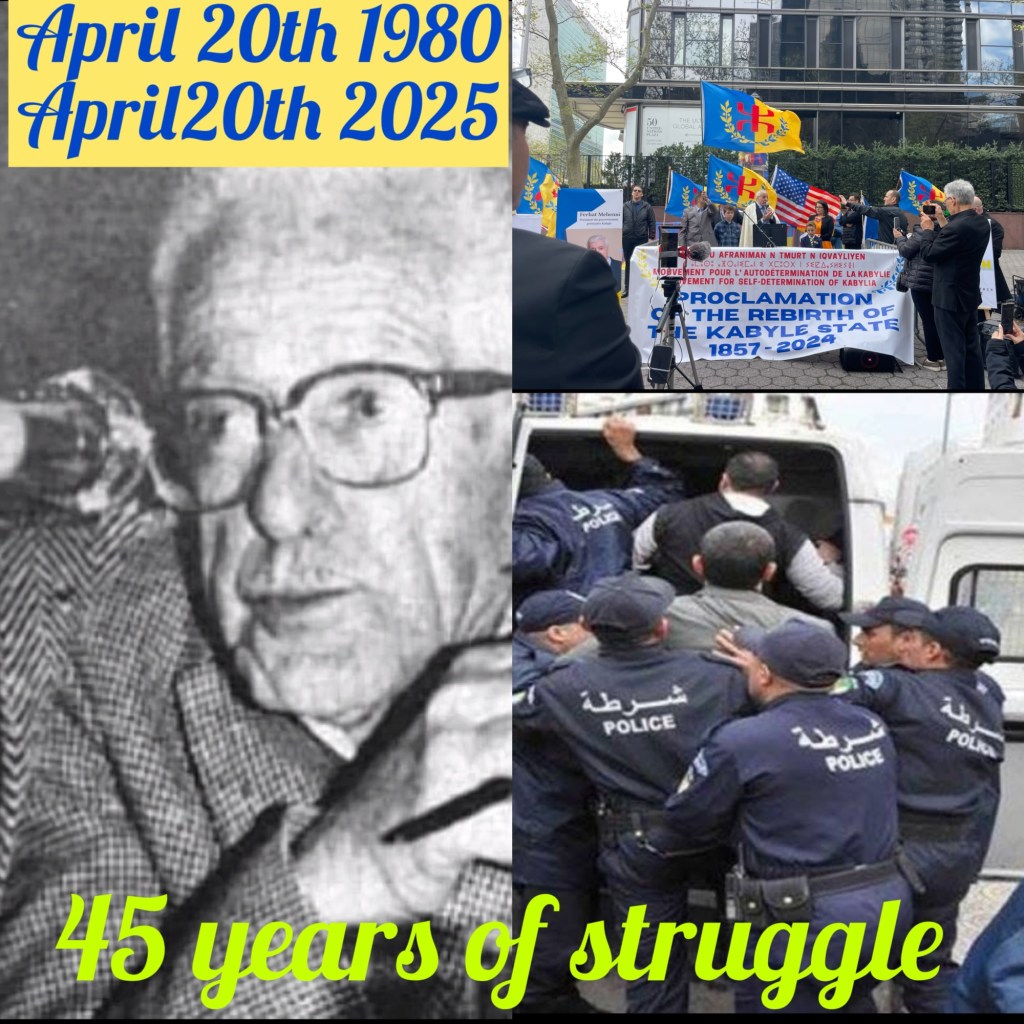
( San Francisco, USA)–April 20th 1980–known as “Kabylia’s Spring”–is a historical date for the Kabylian people for its existential survival against the oppression undergone by the Algerian state to suppress its culture and identity from the beginning of Algeria’s independence in 1962.
From 1962 to 1980, Kabylia was stifled and muzzled, any Kabylian who had boldness and courage to affirm publicly his/her identity was subject to arrest, intimidation, jail, torture and disappearance.
On March 10th, 1980, a lecture was scheduled and supposed to be delivered by Mouloud Mammeri at university of Tizi-Wzu about Ancient Poetry of Amazigh; however, it was cancelled by the Algerian hegemonic regime.
Kabylians to express their discontent towards the Algerian racist regime have started a protesting movement against the denial of the Kabylian culture. It was mainly carried on by high school and university students. Therefore, several strikes and demonstrations were held in Kabylia and in the capital, Algiers.
Then, the Algerian criminal regime retaliated against protesters by utilizing police’s and army’s brutality to quell this legitimate movement. The aftermath of this horrendous repression led to several arrests of students, including university professors, rape and sexual assault of female students, torture of demonstrators, disappearances, and at least around 30 dead and hundreds protesters were injured.
Although demonstrators and protesters were back on street in 1981 to request and demand cultural and linguistic rights for Kabylians, the Algerian state was completely stubborn to satisfy their legitimate aspirations, and continued its denial by implementing a long process of forced assimilation against the native population.
Since then, resistance grew against the ethnic and cultural cleansing that Algeria has planned to engulf Kabylia by promoting Arab and Islam ideology, which was dictated early in sixties by the Egyptian leader: Gamal Abdel Nasser. Thus, Algeria was seen as a new oppressor that replaced French colonialism.
Consequently, each year, Kabylia’s Spring is commemorated and reminded in Kabylia and outside to show attachment and resilience of the Kabylian people to its millenary roots, history, culture, and identity. While peaceful demonstrations are organized in cities to claim to the Algerian state linguistic and cultural rights for the Kabylian people, several activities are also organized in schools, cultural associations, in towns and villages.
Commemoration programs are rich, diverse, and aim to revive and promote Kabylia culture that Algeria has obliterated forcibly. Therefore, aside from wearing traditional attire and serving Kabylian food; conferences, acting shows, poem recitation, music concerts , and sports activities are organized during this commemorative day.
Nevertheless, from 2021, the Algerian military regime prohibited any attempt to commemorate April 20th–demonstrations as well as cultural activities are not allowed in Kabylia. During this symbol and historical day, Kabylia is heavily invested by police forces–anyone who’s willing to participate and/or organize demonstrations or cultural activities is subject to arrest.
This prolonged ban is in fact a devious willingness of the Algerian racist state to erase the memory of April 20th–a perennial date in Kabylia’s cultural struggle–that reunites Kabylians against their planned endangerment. Thus, for the Algerian state dismantling and rooting out the heritage of April 20th is a long term strategy to instill oblivion that will empower the assimilation process, which it has begun against Kabylians.
Currently, thanks to Kabylia’s diaspora, Kabylia’s Spring commemoration is still held each year in foreign countries, and it delivers an outstanding impacts to the acknowledgement of Kabylia people and culture insofar as foreigners–Europeans, Americans, and Canadians are getting increasingly familiar and aware of the issue of the Kabylian people, and this is propelling international support and solidarity to Kabylia.
For this year 2025, as usual, multiple demonstrations and gatherings are scheduled by Kabylia’s Self-determination Movement activists and members. It is also an opportunity to remember the massacre of 130 innocent Kabylians that Algeria assassinated during the “Bloody Spring” of 2001, the thousands injured victims, and the victims of the criminal fires of 2021 and 2023.
In Paris, on April 20th, a demonstration will be held at 2 pm, from Bastille Plaza towards Republic Plaza. In Montréal, at 1 pm a gathering will be held at Émilie Gamelin, followed by a march toward Amnesty international office. In Philadelphia, a gathering will be organized at Philadelphia museum of art at 1 pm. In San Francisco, another gathering will take place at Brick Yard Cove, Berkley Marina.
Beyond remembrance, these international actions are an occasion to call to free Kabylia’s innocent detainees, wrongfully imprisoned by the Algerian military junta, to reaffirm Kabylia’s rights to self-determination and urgently start a decolonization process in Kabylia.
Timeline: Important Events of the Amazigh Spring

 The Kabylia Post
Leave a reply to At Ouali Cancel reply