By Moh Ath- Said
The day of December 14, 2025, corresponding to the Unilateral Declaration of Independence of the Federal Republic of Kabylia, has not made everyone joyful in Kabylia.
This is a historical event for the vast majority of Kabylians who aspire for the independence of Kabylia, however, it triggered schizophrenic reactions of our adversaries. It was also a shockwave for the Algerian colonial regime and its Kabylians clientelist.
This terrorist regime declared : “The MAK has dared again,” and jolted by a phobic panic. It has mobilized certain well-known figures to come to its aid. These people, still enjoying a modicum of public notoriety, seem unaware that now the Kabylian issue transcends them, and the reality of the Kabylian independence movement has relegated them to the ” “political rejects” .
Loyal to the powerful clan at the top of the state, some of these Kabylian figures are attempting to exonerate, or even innocent the colonial regime from its crimes in Larva Nath Irathen without a shred of shame— and for others, it is to participate, to the arrangement of the decorative portrait of the upcoming electoral masquerades or the technical rearrangements of the constitution, hoping to obtain, in this way, a seat among the privileged of the system.
In this “ political-media swamp “ where only the decibels of power can be heard, there is a conductor who, as usual, remains discreet, even though he is the only one who decides the score that must be played. He has the power of life and death over any citizen and is also the only element on the field who is both player and referee.
This refers to the People’s National Army, which, like Islam, is one of the sacred cows that must never be criticized or even questioned.
To do that in Algeria is to throw oneself into the lion’s den and it is wise to write your will in advance and dictate your last wishes to your loved ones.
To understand the chaos currently engulfing Algeria, one must go back to the period of the war of national liberation during which two paradigms relating to the conceptual management of the state opposed and clashed.
There was, in fact, the democratic tendency, embodied by one of the Kabylian actors of the revolution, namely Aban Ramdane, which is essentially based on popular legitimacy once independence was acquired and, the other tendency, embodied by the conservative Arabic movement which believed that revolutionary legitimacy should take precedence over democracy, at least from the first years of independence.
This fundamental disagreement was exacerbated by the renown principle of the latter Kabylian leader.
Prioritizing the civilian politics over the military, and the domestic front over the foreign one. However, this historic leader, by insisting on this principle, had signed his own death warrant. Thus, his assassination constituted the inaugural act of the “zero Kabylian” agenda, which, without openly admitting it, is one of the national constants of the Algerian colonial regime.
After Abane Ramdane’s assassination, who is known to be an adamant politician, it was necessary to get rid of another brave warrior —Colonel Amirouche — who, according to the author of the book ” Amirouche, One Life, Two Deaths,” had been ” sold out ” by the MALG thanks to a deliberately malfunctioning transmission system.
The ensuing series of political crimes and the witch-hunt campaign against the Kabylian had become, in effect, a national constant, alongside Arabization, since the two are intimately linked.
With hindsight, today Kabylians must break the taboos and dare to ask the relevant questions, including the simple ones : Do the Kabylian military and politicians who fought against colonial France bear any responsibility for the misfortunes Kabylia is experiencing today? Were they betrayed by their Algerian comrades even before independence? Were they victims of their obsession for power, to rule over a large country? Is it possible they were so naive to such an extent that they trusted the clan promoting destructive Pan-Arabism more than their Kabylian brothers who were activists for an Algeria that was neither Eastern nor Occidental ? A critical historical analysis is necessary to explain and understand some of the difficulties Kabylia has faced since 1962.
The “zero Kabylian agenda” : a national constant
Without declaring it publicly, the decision to exclude or even eradicate the Kabylians did not begin with the Mostaganem convention organized in 2019, but well before Algeria’s independence.
The leadership held by Wilaya III in the war against France was not to the liking of some Algerians who saw in this wilaya and its army a threat to their plan to seize power once independence was obtained .
To prevent the Kabylians from coming to power, two avenues must absolutely and imperatively be blocked:
A) Access to the highest office in the country for a Kabylian must be prevented and this decision, according to the indiscretions reported by the former President of the RCD, was taken by the grassroots of the ALN in the East.
This resolution could partly explain the replacement of Ferhat Abbes, the first president of the provisional government of the Algerian Republic, a pharmacist, native of eastern Kabylia, who had a modernist vision of the state by a conservative politician Benyoucef Benkhedda, who was also a pharmacist and born in the Mitidja region.
B) In order to annihilate any Kabylian ambition to lead the country, or to take power, it was necessary to disarm the army of wilaya 3 on the one hand, and to replace on the other hand, the ALN with the ANP to justify the attachment of the organizational structures of wilaya 3 to the first military region whose headquarters are in Blida.
The episode of the Kabylia war against Algeria, led by the leader of the Socialist Forces Front, Hocine Ait Ahmed, convinced the military decision-makers who had usurped power at that time of the necessity to get rid of this “strike force of the rebel wilaya three”.
To achieve this, there was no better way than to appeal to the sensitive nationalist sentiments of the Kabylians by creating a diversion around the external threat: “the Sand War ” against Morocco by designating a brother-country as the aggressor through the famous accusation “Hegrouna “.
Naive as the Kabylian are: the first to believe this lie were the Kabylian military leaders who mobilized to defend Algeria.
This desire to deprive the Kabylians of any means of defense continued even during the civil war of the 1990s. Under the pretext of preventing the circulation of weapons, Algerian leaders banned the sale of hunting weapons. Therefore, the Kabylians were particularly targeted, since the the sale and repair of weapons was a Kabylian’s skill. Unfortunately, this is how the gunsmith job inherited from our ancestors, was “knocked down by the Algerian colonial power.”
Omnipotence and omnipresence of the Algerian intelligence services .
Gullible Algerians who believe that the largest employer in the country is the state-owned company Sonatrach, followed by the private company Cevital .
It is undeniable that this nonsense still persists in the collective Algerian imaginary, whereas in reality, that’s the intelligence services that count a plethora of people who work for them or collaborate with them.
This military institution constitutes the nerve center of absolute power in Algeria and the infamous military security apparatus of the seventies has instilled a terrifying terror within Algerian civil society.
The culmination of this terror was reached by the climate of suspicion and mistrust established within members of the same family.
All active spaces within the political, cultural, economic, trade union, and institutional environment were “corrupted” by the military security, which is responsible for all political crimes, notably those of Krim Belkacem (Frankfurt ), Mohammed Khider (Madrid), Ali André Mecelli (Paris), etc
This culture of political crimes, which can now be described as state terrorism, has Soviet influence, since the Algerian intelligence officers, for the most part , were trained by the KGB of the former USSR.
Military security had an eye everywhere and observed the actions and gestures of all citizens and in all environments where men and women of different socio-professional categories are active or in universities.
As soon as the intelligence services’ laser “detects” an interesting student, worker, union member, or activist from an association or political organization who has potential to influence, she/he is systematically approached. The qualities sought in the candidate are: excellent oratory skills, the ability to persuade, the capacity to project credibility, and good looks.
By recruiting a candidate who matches the desired profile, the services kill two birds with one stone:
1- Hiring reinforcement to extend their network of infiltration into all levels of the state
2- Elimination of an active citizen capable of posing a potential danger to the current regime.
As soon as a person seems interesting, the relevant security department approaches her/him and initiates a recruitment process either with the candidate’s personal consent or against his/her will.
The approach of recruitment by personal consent function under two segments of candidates:
a- Those who are motivated by love of country and a desire to participate in its protection against external threats.
b- Those who are obsessed with their innate ambition for power in order to exercise ” hogra” and do not have to suffer it.
The recruitment by force of candidates identified as interesting and potentially dangerous is done in blackmail and corruption or both in many cases, we will support that with examples known to the general public.
The Kabylian people remember the fratricidal duel between the son of an ALN commander and a former party leader regarding his father’s past. Who could have leaked this information, or this lie, to the media?
Only the services have access to the national archives or the French archives and our purpose is not to judge the veracity or falsehood of this information, but we must ask ourselves about the expected objective of this “leak”, the subject of a media battle between these two Kabylians, and at the end, the fight was calmed down by the former DRS.
We can also underscore the case of the leader of the Islamist party, who left in the ministry he managed, a “file related to morally reprehensible behavior, but he was never held accountable for it.”
Even the historic leader Hocine Ait Ahmed was not spared attempts to tarnish his honor by the security services by inventing a sordid and intimate affair with his secretary in order to make him bow down.
All political party leaders and journalists have experienced this kind of dystopian tactics, and many have lost their freedom of action because the compromising dossiers, compiled against them by the former DRS, act like a leash, leaving them vulnerable for political maneuvering.
This is why there is no political opposition in Algeria and those who are currently active, they are merely “decorative human gadgets for the needs of the democracy façade.”
Intelligence services’ dedication for their mission
A country’s intelligence services are the backbone of a national army, and indeed of the entire nation. Their effectiveness and expertise reflect the political, economic, social, and cultural health of a state . They act as a shield protecting all state institutions from external threats and also serve as a tool for proactive intelligence gathering, enabling politicians to take pivotal decisions.
In developed countries, intelligence services are called “intelligence services” since only brilliant men and women are recruited into their ranks, constituting the cream of the national elite, particularly for positions of responsibility.
In Algeria, no glorious exploits have been credited to the political police, except — according to Hicham Aboud , an independent and credible journalist — the decision regarding the nationalization of hydrocarbons in 1971.
Today, Algerian intelligence services are not at the service of the State to supply it with information gathered by counter-espionage in the scientific, technological, commercial, and industrial fields, but their mission is dedicated to the protection and maintaining the current regime to last longer.
These intelligence officers are tasked to prevent any act that could destabilize the precarious balance between the different clans that govern the country and share annuities generated by natural resources.
To this end, these security services are always ready to physically eliminate a potential opponent or create bogus charges against him so that the Algerian subservient justice system arrests and imprison him.
These intelligence services are comparable to a “livestock farm of ruthless spooks , ” capable of torturing and killing a citizen easily. This easiness for killing or torturing a human being is acquired in this ” breeding farm,” where they learn the art of inflicting suffering by stripping to them all sensitivity, feelings and mercy, while simultaneously developing in them the reflexes of a savage beast, devouring any prey that falls into their claws.
These accurate and thoroughly selected thugs with limited intellectual capacity obey the orders of their hierarchy and act with total impunity, the cases of Walid Nekiche and the executioners of Djamel Bensmail are the best illustration.
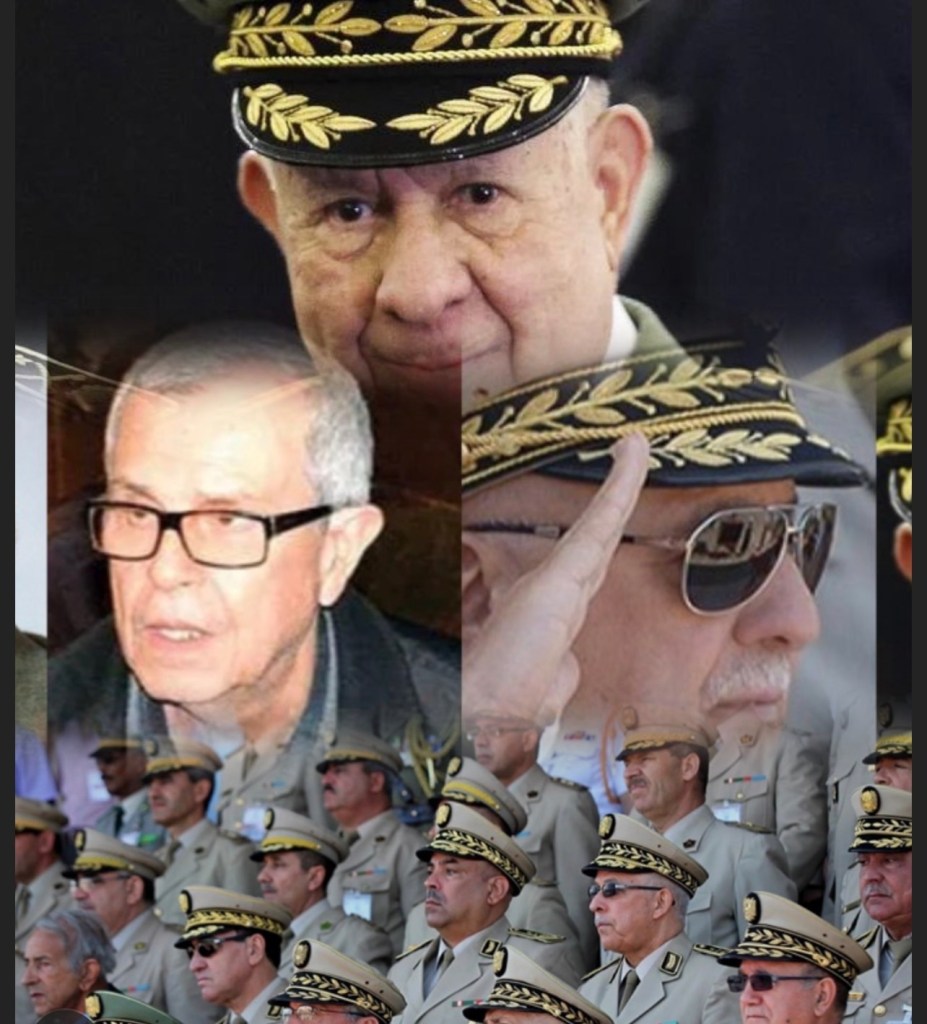
The People’s National Army, the one most disliked by Algerians
Except for the former upright veteran of the National Liberation Army who have remained outside of political regime and who deserve all our respect, the soldiers of the People’s National Army are not appreciated by the people of Algeria.
As a former Algerian, I hold the border army solely responsible for all the misfortunes that continue to befall the people of Algeria, and it is the only one to blame for the chaos into which it has plunged the country since independence. By forcibly imposing Jacobin ideology through a “copy-paste” of the French model, without taking into account sociological, cultural, and identity specificities, the usurpers of power have failed the challenge of uniting all the Algerian people. The resounding ” nahnou 3ereb ” (we are Arabic people), uttered three times by the first imposed Algerian president, is nothing more than a continuation of the agenda concocted by colonial France to Arabize and Islamize North Africa.
In the absence of a vision to build a nation with its diversity, the dictatorial regime since independence has never tried to analyze and interpret the convulsions of the Kabylian society, and this failure explains today the entire multidimensional crisis which, in the more or less long term, will lead to the fragmentation of the country.
The army, in command, is the source of the problems and cannot envision a solution. In the collective imaginary, the army is a tank to welcome all the young people who have failed their school life and opt for a military career, convinced that sooner or later, with a little help from a loved one, success will shine.
The title of army general today evokes for the average citizen the symbol of injustice, corruption, fraud, trafficking of all kinds, and impunity. The citizen scoffs at the medallions adorning the jackets of these military men – medallions, which normally serve as proof of a glorious military feat achieved during a conflict against an enemy.
These soldiers show off their cheap hardware, most of them haven’t even won the schoolyard fight from which they were expelled.
It remains true that some officers have a profile of competence and professionalism, but they are not numerous and often they are not in command positions .
The Algerian army is out of step with the evolution of the world and of science, adding the ignorance of the current leaders , you have in this combination the fuel for a certain and irreversible societal explosion.
 The Kabylia Post
Leave a comment