
Preamble
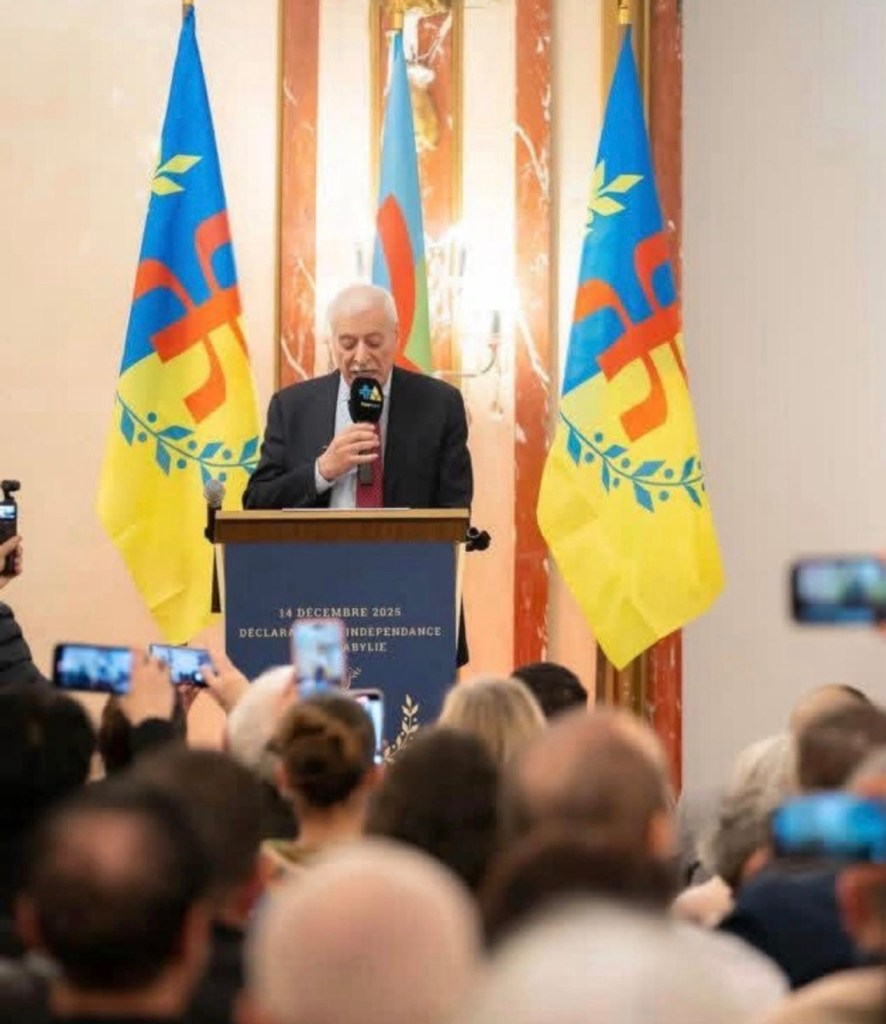
Today, December 14th , 2025, irrevocably marks the advent of a new era for the Kabylian people.
Today, Kabylia — a political entity attested since the third century AD, kingdom until 1871 — puts an end to the subjection in which it was put following its annexation to Algeria more than a century and a half, without its consent.
During this long history, its people have remained true to themselves: their language, their customs, their fundamental values, and above all their deep vocation for freedom.
They are fully aware of what they are: a people.
However, a self-conscious people is, in essence, a nation. Even so that this nation is dominated or administered by an external power does not outrightly erase it. It persists, it lives, it resists. This situation even strengthens its fundamental right to self-determination, especially when its action remains strictly peaceful, as it is the case of the Kabylian people.
For one hundred and fifty years (150 years), Kabylia has endured various forms of oppression without renouncing its values or the affirmation of its identity. Because of its denial, it responded with fidelity to itself. Challenged with violence which directed against its expression, it opposed a serene determination to recover its rights through legal and peaceful means. Faced with attempts to erase it, it deployed a remarkable resilience.
Pacifism is neither weakness nor renunciation: it is the highest expression of reason and humanism. It rejects the logic of destruction, revenge and blood. It is based on justice, dignity and law. It keeps open the ways to a peaceful settlement of disputes, without a winner or a loser.
Nevertheless, when people are denied their extreme existence; when oppression takes the form of a systematic policy of deculturation and depersonalization; when each generation faces the same refusals to exercise its fundamental rights, there is only one possible way out: the liberation. The history of nations is a testimonial to this, and the United States Declaration of Independence remains, in this regard, a major source of inspiration to found our decision on historical, geographical, political, legal, economic and socio-cultural bases.
From the battle of Icerriden in 1857 to the Agellid Amuqran insurrection in 1871, from the Algerian war (1954-1962) to the Kabylia war (1963-1965), from the popular uprisings of 1980 and 1981 to the Black Spring of 2001, through the school boycott of 1994-1995, the mobilizations of 1998, the repression of April 20th, 2014, the so-called “Zero Kabylian” operation of 2019, the arsons of 2021 and the ongoing wave of repression : the Kabylian people paid a necessary price for freedom. Their children resisted, often until the ultimate sacrifice.Their villages continually mourned, but they never consented to submission.
Nonetheless, if Kabylia lost military battles, it never capitulated. No act of surrender was signed. This absence of renunciation makes legally invalid any claim to its domination, whether during the French colonial period (1857-1962) or the one that persists since 1963.
The war that it never lost ends symbolically with today’s Declaration of Independence: it consecrates the victory of Kabylia over its denial and repression. From this moment, it takes a lucid look at its wounds in order to heal them and make them precious stones of its story. It remembers what, helpless, it had to attend:
– The murder or exile of its leaders and symbolic figures;
– The denial of its linguistic and cultural rights, the stigmatization and criminalization of its identity;
– The obstacle to its economic development and the spoliation of its wealth;
– The arbitrary arrest of its children, acts of torture, police and judicial violence, as well as the terror against them.
These realities found and legitimize its decision to take back control of its destiny, to no longer delegate the future of its children to those who have conceived them as a threat to be eliminated.
On this historic day, Kabylia pays tribute to the pioneers of its dignity who marked its resistance from Fadma n’Summer to the anonymous martyrs that history has not yet named.
It salutes political prisoners and activists who, at the risk of their freedom and their lives, keep the flame of hope alive.
It expresses its gratitude to the diaspora who, across borders, carried the voice of the Kabylian people, supported the families of political prisoners and ensured the continuity of the nation.
Because it would be indecent to demand people to renounce their being, immoral to summon them to be silent in the face of injustice, dangerous to entrust their future to those who work to erase them, Kabylia proclaims the rupture of any bond of dependence on the Algerian State.
This break is part of the legacy of the great declarations of independence — 1581 (Holland), 1776 (USA), 1905 (Norway), 1971 (United Arab Emirates), 1993 (Slovakia) and many others that have consecrated the irrepressible right of peoples to live free.
It affirms its commitment to international legality and is based on the principles of the Charter of the United Nations, in particular Resolution 1514 (December 14, 1960), which provides in its article 4:
“It will be stopped all armed action and all measures of repression, of whatever kind, directed against dependent peoples, to allow these peoples to peacefully and freely exercise their right to an outright independence, and integrity.”
The Kabylian people, historically constituted on the territory of Kabylia, now claim their sovereignty over themselves.
The accession of a people to its universal rights cannot depend on the benevolence of the one who dominates it. History has shown that if violence has built empires, freedom has always ended up triumphing over them. And when a people intends to free itself, it has no need for permission.
This preamble is neither an accusation nor a rejection. It is an act of faith: faith in ourselves, faith in our people, faith in our ability to govern ourselves with fairness, intelligence or and humanity.
It is also an act of respect for the peoples of Algeria: the independence of the Kabylia is chance for them. It opens up to them the prospect of a country in line with their aspirations. It offers them a neighborhood of brotherhood and hospitality and a future relationship from state to state, based on equity, solidarity and peace.
On this solemn day, faithful to its history, faithful to its martyrs, faithful to its values, Kabylia puts an end to all domination.
The Kabylian people, proud and sovereign, reappropriate all the rights with which they were spoiled.
Considerings
1. Pursuant that Kabylia is one of the oldest nations in North Africa, attested by the permanence of its territory, the millennial vitality of its language, the solidity of its ancestral democratic institutions and the uninterrupted continuity of its national consciousness;
2. Pursuant that Kabylia was never submitted to the Regency of Algiers and that its annexation, in 1857, by the French colonial power, was made without consent, without treaty and by military constraint alone;
3. Pursuant that, during Algeria’s independence in 1962, Kabylia was integrated into the new State without consulting its people, without a formal act of accession and in flagrant violation of the principle of the free consent of the peoples;
4. Pursuant that, during the Kabylian War of 1963-1965, Algeria militarily occupied Kabylia, which resisted under the leadership of the Front of Socialist Forces (FFS) of Hocine Aït Ahmed;
5. Pursuant that, since 1962, the Algerian State has exercised a systematic policy of negation of the existence of the Kabylian people and their identity, marginalizing their language, repressing their political organizations, hindering their forms of expression and persecuting their peaceful activists;
6. Pursuant that, since Algeria’s independence, Kabylia has been systematically excluded from major policies of planning, economic development and strategic public investment, resulting in a structural deficit in infrastructure, essential services and economic opportunities, and that this planned marginalization has prevented the Kabylian territory from ensuring its development and meeting the basic needs of its population;
7. Pursuant that the Kabylian people have opposed constant peaceful resistance to the destructive assaults aimed at their depersonalization and the dissolution of their forms of organization and solidarity, in particular during the events of April 1980 and 1981, during the creation of the first Algerian Human Rights League, as well as on the occasion of the school boycott of 1994-1995;
8. Pursuant that the Black Spring from 2001 to 2003 was marked by acts of war perpetrated by the armed and paramilitary forces of the Algerian State, causing the death of more than 128 young Kabylians and injuring more than 5,000; this tragedy took place in a total absence of Algerian national solidarity, and that at the most powerful of events, the Algerian parliament led a political trial against Kabylia, in the same time as it buried its children, killed by weapons of war and explosive bullets daily, thus trying to criminalize a legitimate revolt born of injustice and spilled blood;
9. Pursuant that the El Kseur Platform, carried by the gigantic mobilization of the historical march of Kabylia in Algiers on June 14, 2001, solemnly expressed the unity, dignity and determination of the Kabylian people challenging injustice and Algerian state violence;
10. Pursuant that the Declaration of June 5, 2001, by which Kabylia strongly affirmed its right to a destiny parallelly to Algeria, constitutes a founding act expressing the political will of the Kabylian people to take back control of their future;
11. Pursuant that the Constitutive Convention of the Movement for the Autonomy of Kabylia (MAK), held on August 14, 2007, as well as the official presentation of the Autonomy Project, marked the entry of the Kabylian claim into a structured, organized and fully assumed on the political level ;
12. Pursuant that the official correspondence sent by the MAK to the highest Algerian authorities to request a status of wide autonomy for Kabylia remained a dead letter, thus revealing the total absence of will of the Algerian State to enter into a peaceful political solution and recognize the national rights of the Kabylian people;
13. Pursuant that the establishment of Anavad, Kabylia Provisional Government in exile, on June 1, 2010, endowed Kabylia with a legitimate and lasting political representation;
14. Pursuant that the resolution of the MAK National Council, adopted in November 2013 in At Hamdoun, officially formalized the transition from the autonomy claim to self-determination, in accordance with the law of peoples;
15. Pursuant that the Memorandum for Self-Determination submitted to the United Nations in September 2017, formally internationalized the Kabylian issue and constituted a major diplomatic act in favor of the recognition of the Kabylian people;
16. Pursuant that the total ballots boycott opposed by Kabylia to Algeria’s major elections—2019 and 2024 presidential, 2020 constitutional referendum and 2021 legislative elections — were definitely repeated and peaceful expressions of the Algerian State’s refusal of guardianship;
17. Pursuant that the successive tragedies — 1980, 1981, 2001, the arrests of 2019 and 2021, arsons of 2021, acts of torture, expeditious trials and arbitrary convictions — reflect serious violations;
18. Pursuant that the Algerian State’s persistent refusal of any political dialogue and any popular consultation on self-determination makes it impossible for the internal exercise of the Kabylian people’s right to self-determination;
19.Pursuant that international law explicitly enshrines the right of peoples to self-determination, in accordance with the Charter of the United Nations (Articles 1.2 and 55), Resolutions 1514 (XV) and 2625 (XXV), the 1966 International Covenants, the United Nations Declaration on the Rights of Indigenous Peoples (2007), as well as the case law of the International Court of Justice, including the advisory opinion of July 22, 2010 on Kosovo stating that no international standard prohibits a unilateral declaration of independence;
20. Pursuant that the independent legal opinion issued on September 4, 2024 by the firms Brick Court Chambers and Twenty Essex Chambers confirms unambiguously that the Kabylian people are a people within the meaning of international law and that they fully enjoy the collective human right to self-determination, including its restorative form;
21. Pursuant that structural discrimination, institutionalized denial, criminalization of Kabylian activism and existential threats to Kabylia make it legally legitimate, morally necessary and politically inevitable to exercise the right to self-determination by means of a Declaration of Independence;
22. Pursuant that Kabylia, strong of representative political institutions, a structured diaspora and a draft Constitution defining the democratic foundations of its future State, has all the attributes allowing it to fully assume its sovereignty;
23. Finally, pursuant that the MAK’s Convention in October 19th , and the plenary of the IMNI (Kabylian Parliament), on October 24th , 2025, gave a mandate to the President of the Kabylian Government in exile, Mr. Ferhat Mehenni, to proclaim the independence of Kabylia on behalf of the Kabylian people.
OFFICIAL PROCLAMATION OF KABYLIA’S INDEPENDENCE
By respect for the attachment of the Kabylian people to their freedom and dignity;
Having regard to all the considerings that have just been stated;
Based on the mandates entrusted to me by the Extraordinary Convention of the MAK on October 19th , 2025 and by the plenary of the IMNI (Kabylian Parliament) dated on October 24th , 2025;
By virtue of the constitutional powers conferred on me, and in compliance with international legality;
Before Women and Men, in front of History and in front of international bodies, in the forefront of which there is the United Nations; in the presence of political, diplomatic, intellectual and media personalities from all over the world who came to testify to this founding act;
On behalf of the Kabylian people;
On behalf of the Movement for the Self-Determination of Kabylia (MAK) and Anavad (Kabylian Government in exile);
I, Ferhat At SEID, MEHENNI, I SOLEMNLY PROCLAIM THE INDEPENDENCE OF KABYLIA.
This independence takes effect for eternity, from right now when I put my initials on this Declaration;
The Kabylian people recover today, the fullness of their sovereignty over themselves and their territory;
Algerian authority over Kabylia is now foreign to Kabylia and the Kabylian people;
The restoration of Kabylian authority over Kabylia begins today;
In accordance with its Constitution, Kabylia is now a Federal Republic;
It is democratic and secular;
The Federal Republic of Kabylia is the legitimate representation of the Kabylian people at home and on the international level;
The Federal Republic of Kabylia is open to dialogue with the Algerian authorities and international bodies on the modalities of transferring the powers that fall to it by right, naturally and legitimately.
Free and independent Kabylia.
Paris, December 14, 2025

 The Kabylia Post
Leave a comment