
By Aris Ufuzar
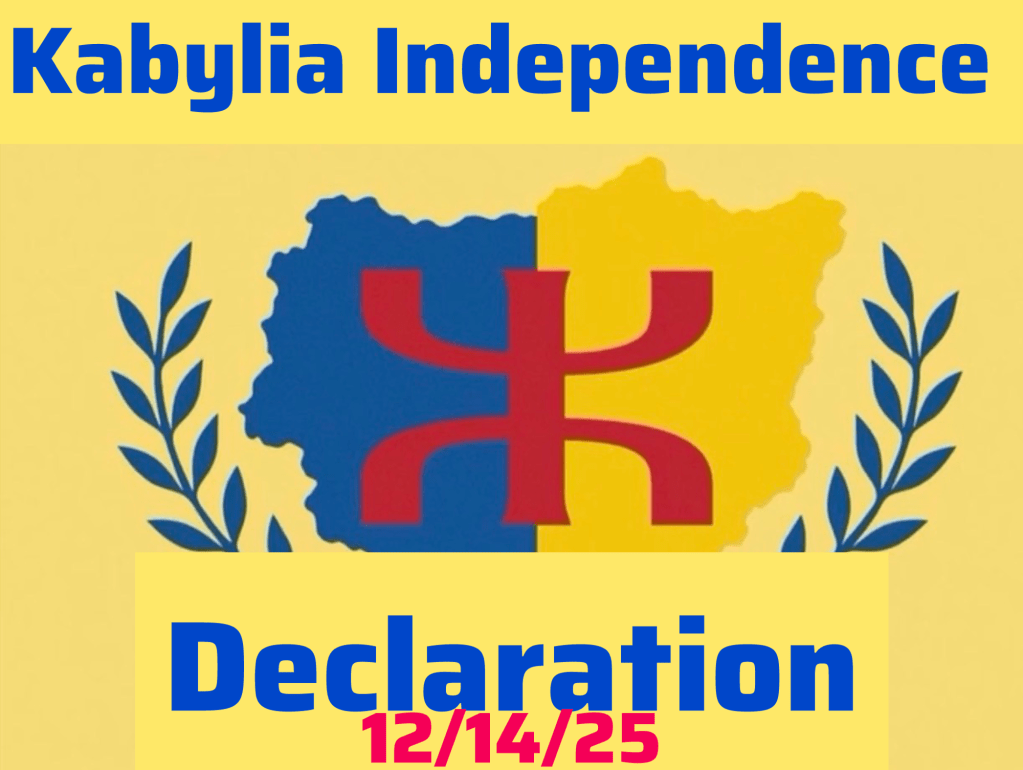
(USA)–The 14th December 2025 is in a few days, and it’s Kabylia’s Independence Day. It will be officially declared in exile, in Paris.
A couple days ago, I was chatting with a relative who immigrated to France the same as many Kabylians because the Algerian military regime made life unbearable in Kabylia, and while we were progressing in the conversation, I mentioned this historical event. Since I’m flying over the Atlantic Ocean to attend the independence’s ceremony, I invited her to join me. However, right away, in a few seconds, she appeared uncomfortable to continue the conversation. I quickly understood she was reluctant to come with me because she fears retaliation from the Algerian regime in so far as she’s visiting Kabylia in mid-January.
Also, I’ll share with you a second conversation with a friend about the project of having an independent Kabylia. My friend is all about the Kabylia independence, nevertheless, his main concern is the time it would take to get an effective independence, or who’s going to pay his dad’s retirement after the independence?
Well! His question was legitimate and fair.
To be honest, there’s no easy answer, it may come soon, take years or centuries, it all depends on the geopolitical situation and international support which Kabylians politicians will face. But, I’m ascertained that this pivotal political decision will open new perspectives on the international level since the Algerian brutal regime is denying to Kabylians to organize a referendum under UN supervion.
Nonetheless, for the dad’s retirement, I replied to him that there will be negotiations with Algeria, and under some legal terms, and according to international laws, Algeria will pay his retirement.
I shared with you my private conversations with a relative and a friend, which I found meaningful and relevant, now I would like to focus on what drives me to support Kabylia’s independence declaration:
- In the Algerian Constitution, Algeria is considered as an Arab country and Islam is the religion of the State. This means there’s neither room for Kabylian people nor religious diversity. Thus, this statement denies existence to the Kabylian people in the current Algeria. The Algerian media often remind us that we’re Arabs. President Ahmed Ben Bella, the first Algerian President, after ascending to power in 1963, affirmed in his first speech, “ We’re Arabs, We’re Arabs, We’re Arabs”. Recently, Algeria has closed over 47 churches, which hurts religious freedom in Kabylia. Therefore, the Algerian constitution is hegemonic, racist, and intolerant towards Kabylians, embodying a deliberate apartheid. As a first conclusion: Algeria State through its Constitution is a colonial State for Kabylians.
- The Algerian school doesn’t offer the acquisition and learning of the Kabylian language to the Kabylian kids at an early age. Instead of their native language – the Kabylian language– It teaches them a foreign language: the Arabic language. This means Kabylia’s kids are undergoing a linguistic assimilation in favor of the Arabic language. This is a devious process aiming to disappear the Kabylian language by replacing it with Arabic language. Second conclusion: A State that promotes a foreign language to the detriment of a native language is unquestionably a colonial State.
- Teaching history in Algerian school is based on lies that glorify the Algerian military regime, which seized and overtook illegally the power after the independence, but not on historical events and facts. Algeria’s military regime is falsifying history, using it as a propaganda to maintain in power as long as possible. Algeria is promoting the teaching of the Arab and Ottoman invasion as a positive historical fact, rather than teaching the history of the natives, the land’s owners: the Amazigh people. Leaders and kings like Massinissa, Jugurta, Aksil, Dihya, Fatma N’ssoumer…are omitted and forbidden in Algeria’s history books. Third conclusion, falsifying history of someone’s people is a willingness to pervert and erase the identity’s foundation of the Amizigh people, including the Kabylian people, and this is a pure colonial act.
- Algeria post-independence killed about 500 Kabylians in 1963 in an insurrection led by the Socialist Forces Front (FFS) against the dictatorship implemented by H. Boumediane and President Ahmed Ben Bella. Fourth, Kabylia had an early aura about the Algerian domination which it was entangled.
- Algeria post-independence has assassinated many intellectual and political figures who oppose the Algerian military regime’s official narrative. Krim Belekacem, Ali Mecelli, Mouloud Mammeri, Taher Djaout, Matoub Lounes are among the victims of the Algerian criminal regime. Fifth conclusion, killing leaders of any people, who contribute to enlighten their fellow citizens is an attempt to make it easier to subdue and subject the average citizens, and this is called a harsh colonialisme
- Algeria doesn’t issue Kabylians official documents like identification documents (ID) or passports in their native language. Sixth, owning an ID document in a foreign language is a blatant fact of colonialism.
- Algeria, in 2001, assassinated 130 peaceful demonstrators, and injured about 6000. Seventh, targeting youthful civilians who were seeking recognition and a better life is a genocide attempt.
- The Algerian military regime burned Kabylia in 2021. The aftermath of this heartbreaking act left at least 250 dead, and a devastated fauna and flora. The Algerian regime then blamed the MAK movement, Morocco and Israel. Furthermore, Algeria has condemned to prison over 500 innocent Kabylians, including 38 who were sentenced to death, and forced thousands to exile. Eighth, Triggering a scorching-earth policy is also a means to hurt Kabylia’s soul, instill fear by disappearing its people.
- Algeria is exploiting an illegal mine in Kabylia, in the Thala Hamza region. This project doesn’t have the approval of the civil society, displaced population from their own land. It is a health hazard to the entire region. Ninth, compulsorily displacing people from their ancestry land is a grave violation of international law, and a serious human right abuse.
- Kabylia’s future is led by the MAK movement – Kabylia Self-determination Movement – It is a structured and peaceful movement, marked by competence and resilience. It aims to bring back freedom, dignity and sovereignty that had been stolen to its people by ending decades of harsh treatment and impoverishment. Kabylia independence will bring wealth and happiness to its people, and a durable peace in the Mediterranean Region.
 The Kabylia Post
Leave a comment