By Raveh Urahmun, sociologist
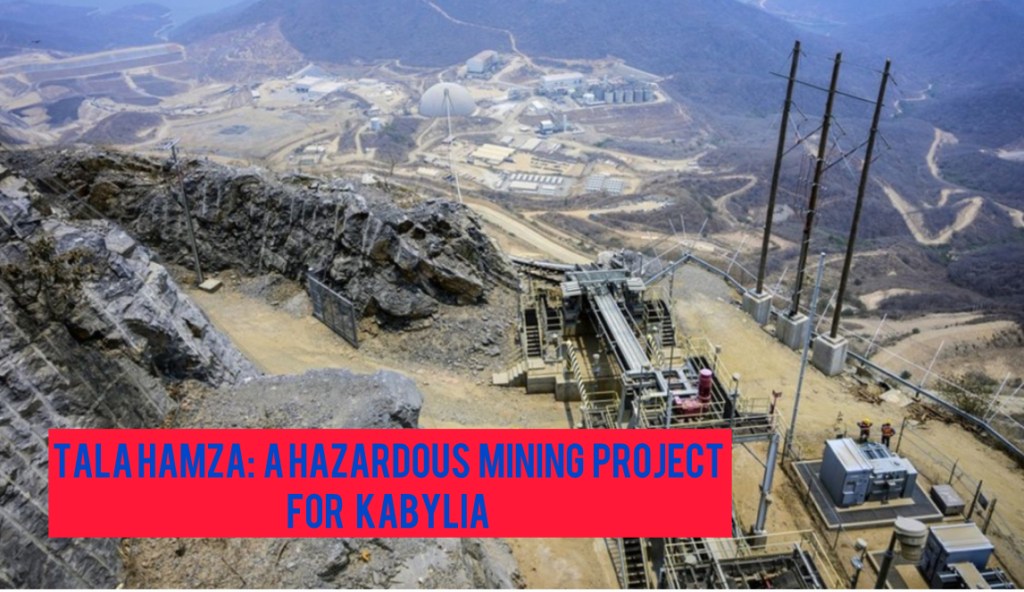
(Exile, Paris)–The project to operate the Tala Hamza-Amizour zinc and lead deposit is in the final phase of legal and administrative validation, with a view to the upcoming launch of the work. It covers an area of 134 km², including the municipalities of Tala Hamza, Amizour, Boukhelifa, El-Kseur and Oued Ghir. Production is scheduled for July 2026. Tala Hamza is not just a mining subsoil. It is above all the Soummam watershed, an area classified as RAMSAR (https://rsis.ramsar.org/ris/1898) for its ecological richness and unique biodiversity. Beyond this protected perimeter, mining concessions also extend to strategic agricultural land, essential to Kabylia’s food security. This project thus directly threatens a vital, densely populated territory: the Soummam corridor, between El-Kseur and Vgayet, which is home to nearly 320,000 inhabitants.
An executive decree (No. 23-320) recently classified Tala Hamza as a “public utility operation”, authorizing the expropriation of private land necessary for the construction of the mine, access roads and associated infrastructure, while drastically reducing the possibilities for legal recourse. No popular consultation took place. This is hardly surprising, as the Algerian State is aware of the visceral link of the Kabylian people to their land. For the Kabylian people, this project is experienced as a serious cultural attack, an existential aggression.
A major ecological, health and food threat
This industrial project represents an unprecedented ecological and health risk: pollution of the Djurdjura water table, contamination of air, soil and food resources, destruction of arable land. A serious attack on the food sovereignty of the surrounding populations and of Kabylia in general making its inhabitants dependent on the outside for their survival.
Beyond pollution, the dangers associated with the exploitation of lead are well documented: neurotoxic effects, chronic diseases, risks for children and pregnant women. (I invite the Kabylians to educate themselves on this fact. It’s about the future of their children). There is also talk of serious geological risks in this already sensitive region (landslides, seismic instability…).
Towards a massive displacement of populations
Another consequence, more devious but just as dreadful, is the massive displacement of populations. This project is part of the “zero Kabylian” policy decided in the highest authorities of the Algerian State, which continues on a larger scale following the criminal fires from 2021 to 2025, the refusal of drugs sent by the Kabylian diaspora during the Covid-19 period, terror, massive arbitrary imprisonment, forced exile of youth, the gradual replacement of local populations, and now, their dispersion. These populations will be uprooted, away from their ancestral lands, their collective memory, their culture. And this is certainly the main objective of the regime.
As I have already written, this policy seems to be inspired by the sinister Nazi theory of three thirds:
– A third must perish,
– A third party must be imprisoned or exiled,
– A third must be submitted, reduced to the status of servant.
– Increased militarization for total control
The other real ambition of the Algerian State is to strengthen control over Vgayet and Kabylia as a whole, through increased militarization, as if more than a third of the military-security forces already deployed were not enough. The regime will certainly invoke the security of the mine and its surroundings.
International law and indigenous peoples
It is important to remember that the United Nations Declaration on the Rights of Indigenous Peoples (UNDRIP), adopted in 2007, clearly states that these communities have the right to self-determination, including control of their land and resources. Article 26 affirms this right explicitly, as does the principle of free, prior and informed consent, which requires States to consult with indigenous peoples before any project affecting their territories. This principle is based on the recognition of the unique spiritual, cultural and economic links that indigenous peoples have with their lands and that these relationships must be respected in all resource extraction activities.
However, Algeria has signed Convention 169 of the International Labor Organization (ILO), as well as the American Declaration on the Rights of Indigenous Peoples, which recognize and protect these fundamental rights. Yet these commitments remain a dead letter.
A cry of anger and concern
Personally, this project terrifies me. It embodies everything that Kabylia rejects: dispossession, contempt, the destruction of identity. Even worse, for me, is the complicit silence, the cowardice, even the betrayal of some Kabylian political and intellectual elites. Some “Algerianists” even dare to support this regime while looking away from the programmed disappearance of their own people. When I hear the “Algerianists” shouting their support for the regime and look without plugging in the destruction of their being because, a Kabylian without Kabylia is no longer a Kabylian, but a shadow, an uprooted that history will judge. It becomes difficult to put the exact term to name them.
This article is inspired by some technical data from the article written by journalist Nicolas Beau appeared in Monde Afrique based on the work of Charlotte Touati, a researcher affiliated with the University of Lausanne, specialist in security-defense subjects in the Horn of Africa and North Africa.
 The Kabylia Post
Leave a comment